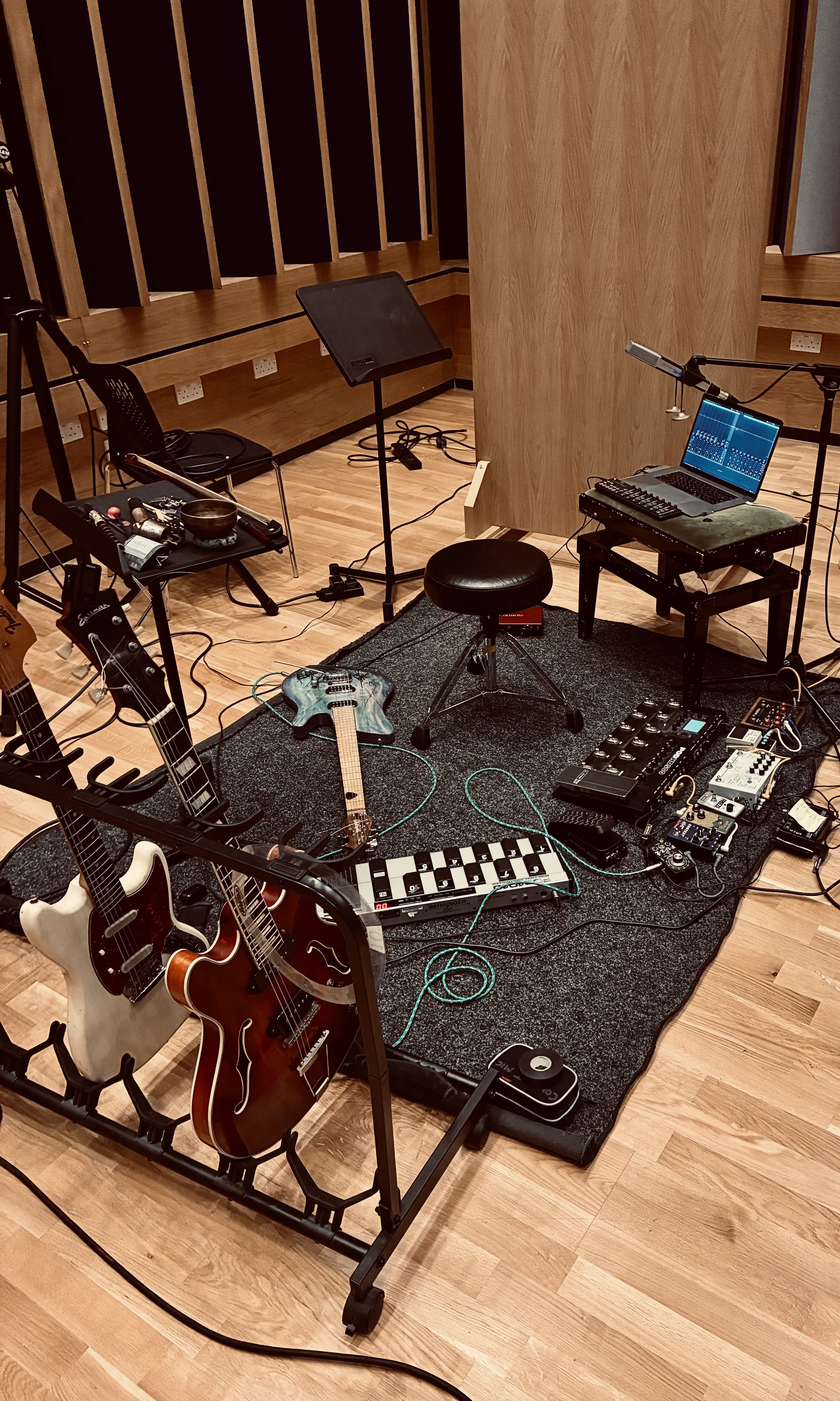
Solo Work
My solo study consists of delving into greater detail the relationship between improviser and amplification. I am enthralled by the concept of an immersive sonic exhibition and extended improvisation where the listener has the ability to control their own perspective of the sonic art they’re perceiving. Exploring multiple distinct signal paths, all being triggered by the same acoustic input source. I aim for complete synergy between the action of improvisation and the manipulation of said exploration. To be able to treat my setting as malleable, yet uncontrollable.
The Origin.
This idea started from my experience as a creative within the extended improvised music scene of Leeds (UK), who although specialised in the craft of electroacoustic music and sound manipulation, felt that amplification was too often regarded as a compromise — a logistical fix to a quieter instrument. I aimed to challenge this notion by centering amplification and technological manipulation as essential tools of expression. I want to rebel against the notion of acoustic purity, but rather embody a post-acoustic identity, whilst still aiming for the same organic relationship one has with a traditional instrument. I am not acoustic, and I do not wish to be constrained by that framework. By building a system which enables me to route sound through multiple speakers, which are manipulated in separate streams which I strategically place around any architecture, I ‘play’ the space itself. The listener experiences unique resonances and phase relationships based on where they are placing themselves in a room, inadvertently immersing themselves into a living, evolving sonic architecture. It is an acknowledgment of the power of spatiality in sonic art, not as background but as medium. The loudest speaker a participant hears will sub- consciously cause the other speakers to sing in a consonant or dissonant manner against the lead tone, and this will be a different for each individual inside the space dependant on their positioning.
The Reason.
This concept in my eyes bridges contemporary sound art, multichannel systems, live performance and electroacoustic composition - transforming any space into a resonant chamber of exploration. It invites and challenges listeners not only to perceive, but to feel and navigate sound as a sculptural presence. It offers a distinct departure from conventional immersive audio works by subverting two foundational assumptions: that the conceptualiser must dictate the sonic narrative, and that amplification is purely utilitarian. While many spatial sound installations seek to envelop the audience with a unified field of sound, my work aims to decentralises sonic authority. Instead, to create a fragmented but coherent sonic ecosystem in which each listener becomes responsible for their own auditory experience by simply existing and moving within the space. It shifts the relationship of performer being an author and perceiver being a reader, to both being ‘co-creators’ for each individual’s experience.